Sesame paste · premix before batching
Black Sesame Milk Tea
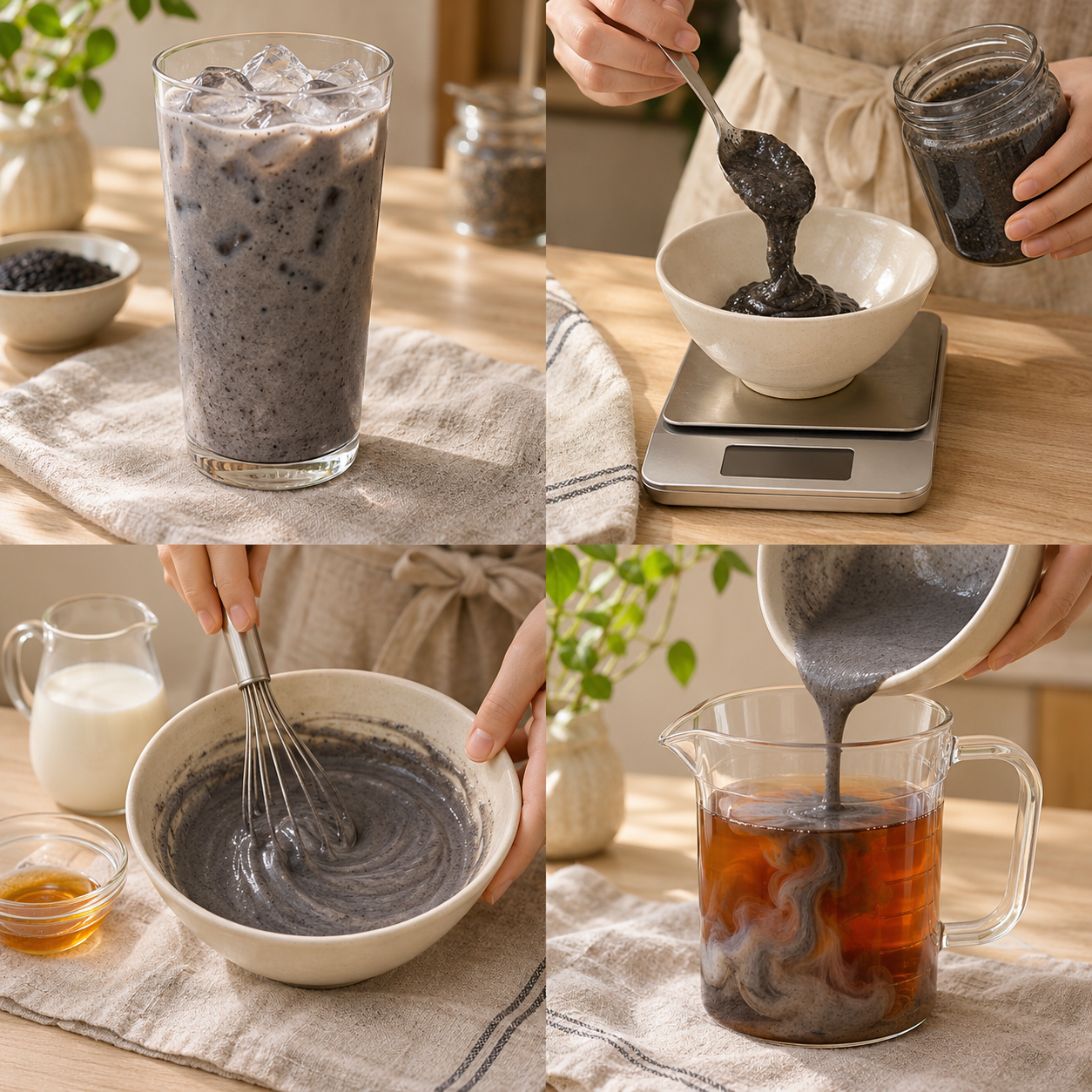
Disperse ready-to-use black sesame paste in a small measured milk portion before adding tea. Plan a separate mixing station and stir the serving jug as needed rather than treating the paste like syrup.
Untested starting adaptation for party planning. Manufacturer and producer recipe references support using black sesame paste in milk drinks; they have not validated this tea formula, quantities, cup fill or yield. Test the exact jar, milk and tea before scaling. The table plans a 500 mL cup; the 12-cup column excludes an extra buffer.
Ingredients for one cup and 12 cups
| Ingredient | 1 cup | 12 cups |
|---|---|---|
| Filtered black tea | 200 mL | 2400 mL |
| Milk | 170 mL | 2040 mL |
| Simple syrup | 15 mL | 180 mL |
| Unsweetened black sesame paste (ready to use) | 15 g | 180 g |
| Ice space, not weight | About 80 mL | About 0.96 L |
Liquid amounts and occupied cup volume are different. Powder and toppings change fill; test the actual cup and lid. Measure ice weight separately instead of treating milliliters of reserved space as grams.
Equipment and purchasing
Scale, tea strainer, measuring jug, mixing bowl, small whisk, flexible spatula, serving jug and dedicated pouring utensil. Also prepare compatible cups, lids, straws, labels and paper towels.
Subtract usable stock from the net requirement, then round up to whole packs. Read ingredient and allergen labels on the actual products. Check the ingredient guide →
Method and batch order
- Check that the jar contains ready-to-use unsweetened black sesame paste and read the actual ingredient and storage labels. This formula does not use raw sesame seeds, sesame oil or a sweetened instant latte powder. If the product label directs you to stir separated oil back into the paste, do so before weighing. Weigh 15 g paste into a mixing bowl; do not convert grams of paste into the same number of milliliters.
- Reserve 30 mL from the planned 170 mL milk and work it into the paste gradually with the 15 mL syrup. Scrape the bottom and sides until the mixture is evenly dispersed, with no thick pockets on the spatula. The remaining 140 mL milk belongs to the tea base. A jar with a different grind or added sweetener needs a separate trial; adding unmeasured water changes both strength and planned volume.
- Prepare and filter tea using its own product instructions, then measure 200 mL filtered yield. Mix the sesame concentrate with the tea and remaining 140 mL milk. Trial the actual 500 mL cup, starting with about 80 mL reserved ice space. Paste displacement, residue and ice shape affect the fill. Check the pour at the start and later in the serving sequence; stir the jug as needed so one guest does not receive most of the sediment.
Scale ingredient amounts by the confirmed cup count, but do not multiply brewing or cooking times by guest numbers. Follow the selected product instructions for preparation and holding.
Hosting and refilling
Before shopping, confirm guest preferences and ingredient restrictions. Make a trial cup before calculating batches. Keep each jug within its working capacity and label it “Black Sesame Milk Tea” with the actual milk and sweetener information.
Arrange cups, toppings, drinks and napkins in order. Assign one refill point away from the guest queue. For this recipe, check the specific preparation bottleneck: scale and the tools listed above must be available when their step begins.
Keep reserve ingredients under their product-specific conditions. Record actual cups served and remaining ingredients rather than assuming the planning amount is a measured yield.
Batch workstations and serving order
Use this as a separate paste-based option alongside a plain milk tea. Sesame is an additional ingredient to disclose: retain the jar label and make the sesame-and-milk identity clear at the serving point. A separate whisk, bowl and jug help organize the task but are not an allergen cross-contact guarantee.
For 12 cups, the table estimates 180 g paste, 2,400 mL filtered tea, 2,040 mL milk and 180 mL syrup. Put 360 mL of that milk at the paste-mixing station and 1,680 mL at the tea-mixing station. The two milk allocations add up to the one milk total in the shopping list; do not purchase an extra 360 mL on top.
Measure the product jar in grams. If there is no usable stock and a jar contains 200 g of the same paste, a 180 g requirement means one jar, with a planned 20 g remainder before bowl losses. Follow that product’s instructions for any remainder; do not assume a generic opened-jar life.
Make a trial concentrate first, then choose the batch size that your bowl and whisk can mix evenly. Transfer each batch with a spatula and record what remains on the bowl rather than calling every gram of input a gram served. If the bowl cannot comfortably handle the full party batch, split the weighing and mixing tasks.
At the table, keep this jug distinct from the plain tea and the foam-topped option. Place its dedicated stirrer where the serving person can remix without reaching over guests. Pour a small group of cups, observe uniformity, then prepare the next group as demand requires. Retain product-specific holding conditions throughout.
The planner reserves 80 mL cup space for ice per 500 mL cup, or 960 mL for 12 cups. That is not 960 g of purchased ice. The liquid inputs sum to 385 mL per cup before paste; neither that arithmetic nor a photograph proves that all ingredients fit every 500 mL cup. If adding an optional topping, trial the fill again and explicitly adjust the next batch.
Troubleshooting and adjustments
Thick streaks on the bowl: work the reserved milk into the paste gradually and scrape the sides before adding tea. Gritty texture: confirm that the product is a smooth ready-to-use paste, not coarse ground seeds; extra syrup will not remove seed particles. A weak final cup: check that you used filtered tea yield rather than starting water, and record any liquid left in the mixing bowl. Uneven color between cups: remix the serving jug before the next small group of pours rather than topping up the palest glass with unmeasured paste.
Change one variable per trial. Record the product, amount, actual fill and result. Do not infer allergen suitability or storage life from the appearance of a drink.
Add this drink to your party
Plan quantities for this drink ↗Method references and recipe status
- Kadoya Sesame Mills: black sesame soy latte
A sesame manufacturer’s reference for combining black sesame paste with a milk-based drink. Its recipe uses coffee and soy milk, not this tea formula; no brewing time, portion or nutrition claim has been transferred.
- The Japanese Pantry: Black Sesame Latte, attributed to sesame producer Takehiro Wada
A producer-attributed example of dispersing paste with sweetener and a small liquid portion before adding milk. Our tea, milk, paste and ice planning amounts are an untested adaptation, not its measured recipe.